July 24, 2026
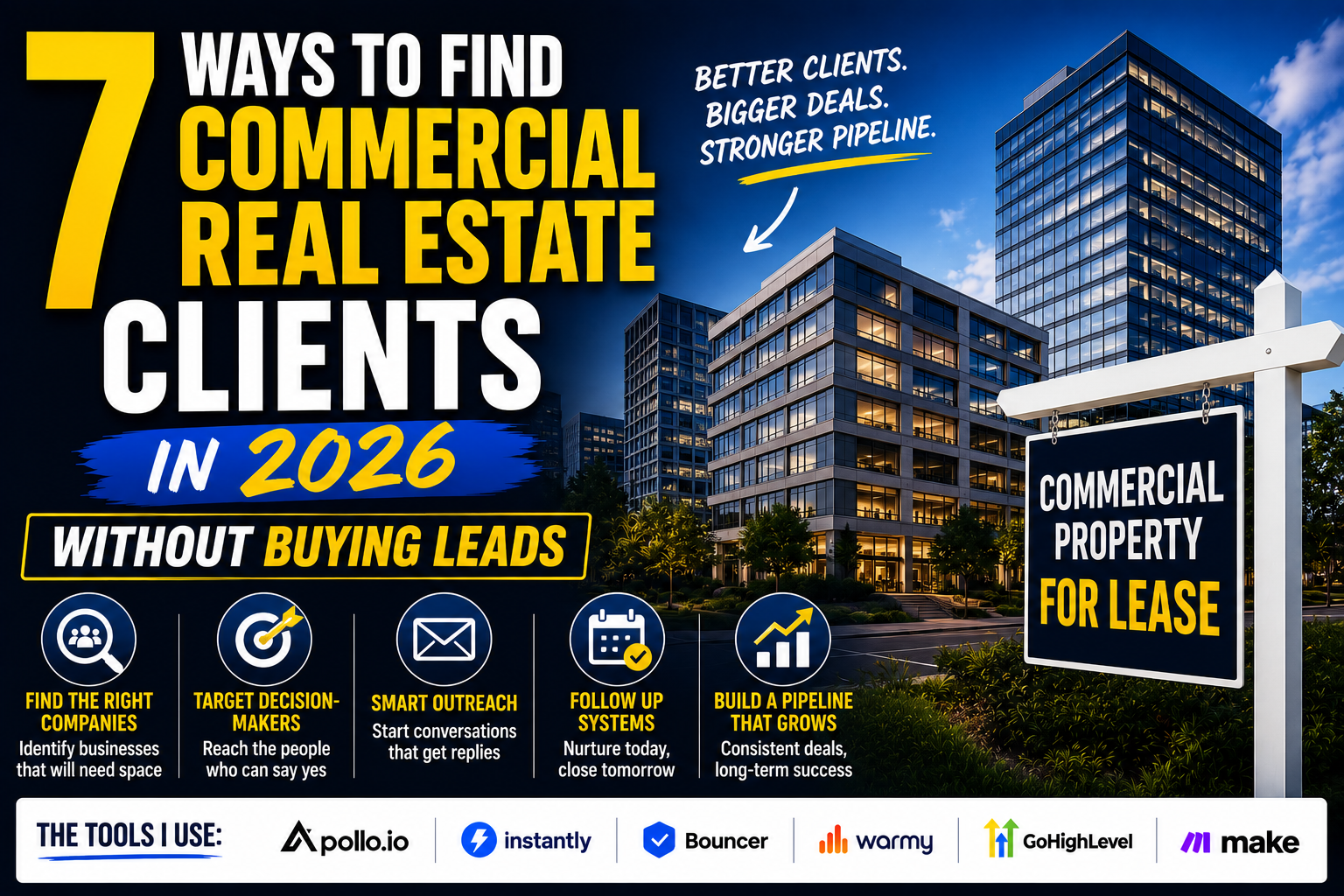
7 Ways to Find Commercial Real Estate Clients in 2026 (Without Buying Leads)
Real Estate
Click here to checkout the software

Buying leads sounds convenient.
You pay for a database, receive hundreds of contacts, and start prospecting.
The problem?
Your competitors probably bought the same list.
If I were trying to build a commercial real estate business in 2026, I wouldn't want more random leads.
I'd want to know which companies are likely to need property—and when.
That's a very different approach.
Here are seven ways I'd find commercial real estate clients without depending on expensive shared lead lists.
One of the strongest commercial property signals isn't a property search.
It's business growth.
Imagine a company has:
There's a reasonable chance its property requirements could change.
That doesn't mean you immediately send:
"Do you need a bigger office?"
Instead, add the company to your target account list and research what's happening.
Look for signals such as:
You're trying to identify potential property demand before the formal search begins.
That's much more valuable than contacting every company in your city.
Once you've identified an interesting company, the next question is:
Who should you actually speak to?
Depending on the organisation, that might be the:
For investors, you might instead target:
This is where a B2B database becomes useful.
Apollo lets you search companies and identify relevant decision-makers using criteria such as industry, geography, company size, and seniority.
Try it here: Apollo.io
Free plan available.
The objective isn't finding 10,000 email addresses.
I'd rather have 101 carefully selected accounts with a genuine reason to contact them.
This is one of my favourite prospecting signals.
Suppose a company suddenly advertises:
23 jobs in Bristol.
But its current office is in London.
That's interesting.
Maybe they're building a remote team.
Maybe they're opening a new location.
Maybe they're acquiring another business.
You don't know yet.
And that's precisely why there's an opportunity to start a conversation.
You could reach out with something like:
Hi Sarah,
I noticed you're currently growing the Bristol team.
I'm researching business expansion across the local office market and was curious whether the growth is being handled remotely or whether you're considering a physical location in Bristol.
Happy to share some recent availability data if useful.
You're not pretending to know they need property.
You're using a legitimate business signal to start a relevant conversation.
This is where commercial real estate becomes a long game.
Imagine you discover a company's lease expires in 18 months.
That's not a bad lead.
It could be an excellent lead with bad timing.
Add the company to your CRM.
Then build reminders:
Research the account.
Start relationship building.
Discuss future requirements.
Explore available options.
Active property search or lease negotiation.
Suddenly, your CRM isn't just storing contacts.
It's telling you when opportunities may become relevant.
A platform such as GoHighLevel can help manage pipelines, reminders, forms, communication, and automated follow-up.
Try it here: GoHighLevel
Free trial available.
Companies looking for premises and investors looking for assets shouldn't receive the same outreach.
An occupier cares about things like:
An investor might care more about:
So I'd create separate databases.
For example:
Database A — Occupiers
Businesses potentially requiring offices, warehouses, retail units, or industrial facilities.
Database B — Investors
Individuals and companies acquiring commercial assets.
Database C — Developers
Businesses looking for land, development opportunities, or repositioning projects.
Different client.
Different problem.
Different outreach.
Commercial real estate is one area where I think cold email can work extremely well when it's done properly.
But I'd keep campaigns small.
Don't send:
We are a leading commercial real estate agency offering a comprehensive range of solutions...
Nobody cares.
Instead:
Observation → Reason for contacting → Question
For example:
Hi Mark,
Saw you're recruiting heavily around Leeds at the moment.
We work with businesses evaluating industrial and warehouse space around the area.
Are you expecting the current facility to handle the additional capacity, or is expansion something you're exploring this year?
That's enough.
If you're running structured campaigns, Instantly can automate the initial outreach and follow-up process.
Try it here: Instantly
Free trial available.
I'd still keep the human involved as soon as someone responds.
This is where everything comes together.
Most businesses think:
CRM = people I'm currently selling to.
I'd think:
CRM = everyone I may realistically do business with over the next five years.
Track things like:
Then segment prospects:
Now
Active requirement.
Soon
Potential requirement within 12 months.
Later
Long-term relationship.
Investor
Looking for acquisitions.
Landlord
Potential future instruction.
Now you're building an asset.
If you're using outbound email, list quality matters.
I'd verify contacts before putting them into campaigns rather than repeatedly sending to invalid addresses.
Bouncer is designed for email verification.
Try it here: Bouncer
If you're operating dedicated outbound inboxes, you can also use a deliverability platform such as Warmy.
Try it here: Warmy
The goal isn't maximum sending volume.
It's getting relevant messages in front of the right people.
There are plenty of tasks I'd automate:
Make is useful for connecting these different systems.
Try it here: Make
Free plan available.
But I'd draw a clear line.
Automate administration.
Don't automate relationships.
Once someone is genuinely interested, the broker should take over.
If I could monitor only five things, I'd choose:
These give you a reason to contact someone.
And having a reason makes prospecting much easier.
I wouldn't:
I'd rather identify 51 excellent companies than 5,001 mediocre prospects.
Finding commercial real estate clients isn't really about finding leads.
It's about identifying future property decisions.
Companies grow.
Warehouses become too small.
Leases expire.
Investors raise capital.
Businesses relocate.
Developers look for opportunities.
Most of those events leave signals before a transaction happens.
The opportunity is to spot those signals, identify the right decision-maker, start a useful conversation, and maintain the relationship until the timing is right.
That's a much stronger strategy than buying another list of people your competitors are already contacting.
Our latest news and trending topics