July 29, 2026
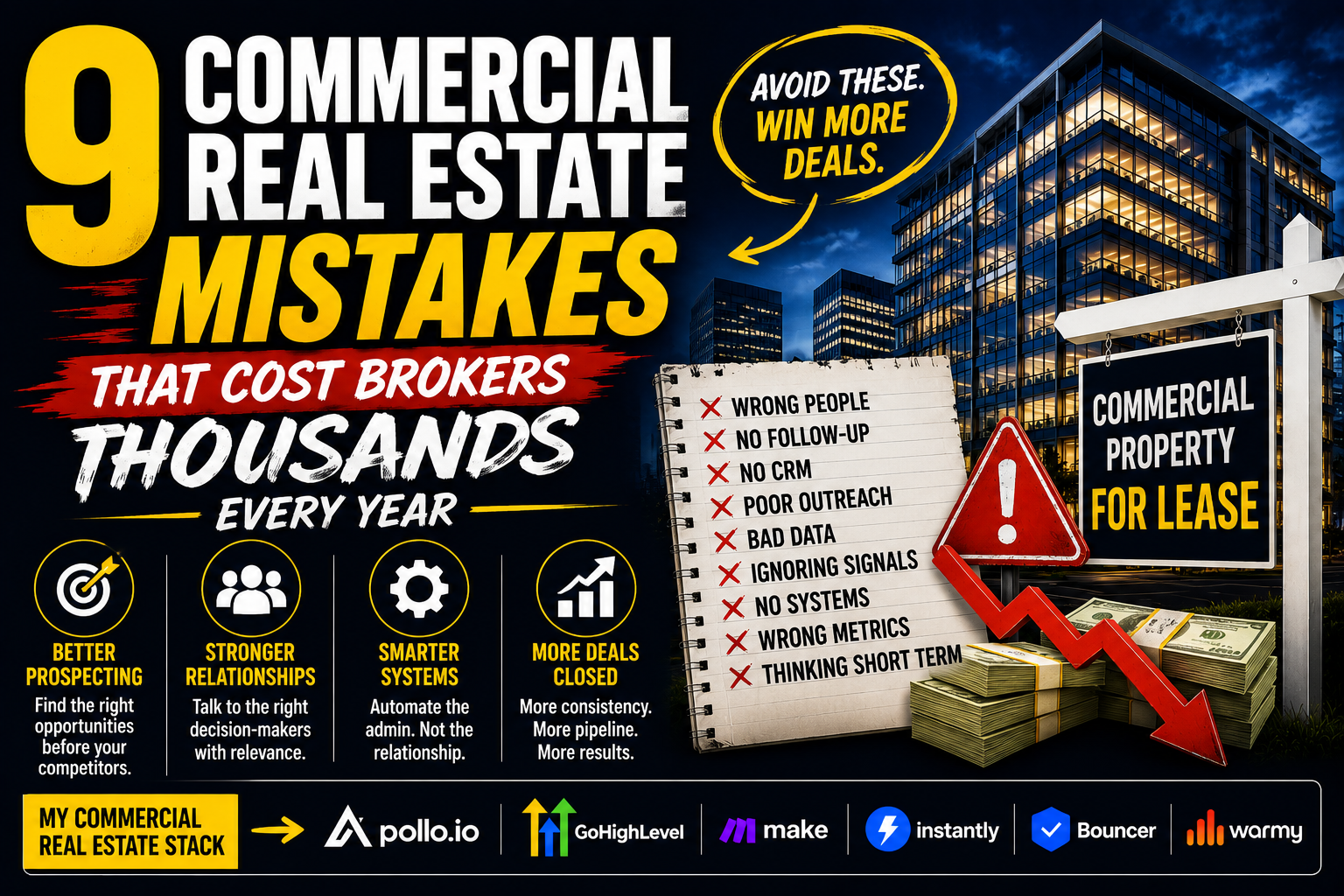
9 Commercial Real Estate Mistakes That Cost Brokers Thousands Every Year
Real Estate
Click here to checkout the software
Success in commercial real estate rarely comes down to luck.
It comes down to systems.
The best brokers don't necessarily know more people or have larger marketing budgets.
They simply avoid the mistakes that quietly destroy pipelines, relationships, and future opportunities.
Some of these mistakes don't hurt immediately.
Months later, however, you realise you lost a client, forgot to follow up, or watched a competitor close a deal that should have been yours.
Here are nine mistakes I see repeatedly—and how I'd avoid them.
One of the biggest misconceptions in commercial real estate is believing that good opportunities simply appear.
They don't.
Businesses expand.
Warehouses become too small.
Companies relocate.
Investors raise new capital.
Those opportunities usually leave signals long before anyone starts searching for a broker.
Successful brokers proactively identify those signals instead of waiting for enquiries.
Finding a company isn't enough.
You need to find the person responsible for property decisions.
Depending on the business, that might be:
Apollo makes researching decision-makers much faster through filters like industry, company size, geography, and seniority.
Try it here: Apollo.io
Free plan available.
One good contact is worth far more than fifty irrelevant ones.
A developer.
An investor.
A manufacturer.
A retailer.
All require completely different conversations.
Many brokers send identical emails to everyone.
Instead, segment your database and personalise your outreach based on each company's situation.
Relevance almost always beats volume.
Commercial real estate transactions often take months.
Sometimes years.
Yet many brokers stop after one email or one phone call.
Instead, create a structured pipeline with reminders for:
Consistency creates opportunities.
Trying to manage dozens of conversations from memory rarely works.
A CRM helps you track:
GoHighLevel combines CRM, automation, forms, pipelines, calendars, and communication tools in one platform.
Try it here: GoHighLevel
Free trial available.
The software isn't the advantage.
The consistency is.
The best email in the world is useless if it lands in spam.
Before launching outbound campaigns:
Try it here: Bouncer
Try it here: Warmy
Deliverability isn't exciting.
But it's often the difference between getting replies and getting ignored.
Automation should reduce administrative work.
Not replace genuine conversations.
I'd happily automate:
I'd never automate trust.
Use Make to connect your systems while keeping personal conversations human.
Try it here: Make
Free plan available.
Many brokers obsess over:
I'd rather monitor:
Those numbers actually grow the business.
The best commercial brokers understand one simple fact:
Today's "no" often becomes next year's transaction.
Companies change.
Leases expire.
Funding arrives.
Expansion happens.
A CRM isn't simply a database.
It's a record of future opportunities.
The broker who remembers the conversation six months later usually wins.
Commercial real estate is a relationship business.
Technology won't replace trust.
But it can help you stay organised, follow up consistently, and spot opportunities before your competitors do.
Avoiding these nine mistakes won't guarantee success.
It will, however, remove many of the obstacles that quietly prevent brokers from building a predictable pipeline.
Over time, that's often the difference between chasing deals and consistently closing them.
Many brokers stop following up too early. Commercial transactions often have long sales cycles, so consistent relationship management is essential.
Yes, but mainly for administrative tasks such as reminders, CRM updates, notifications, and workflow management. Client relationships should remain personal.
A CRM helps brokers track conversations, future opportunities, follow-up schedules, lease events, and client history over long sales cycles.
Our latest news and trending topics