July 24, 2026
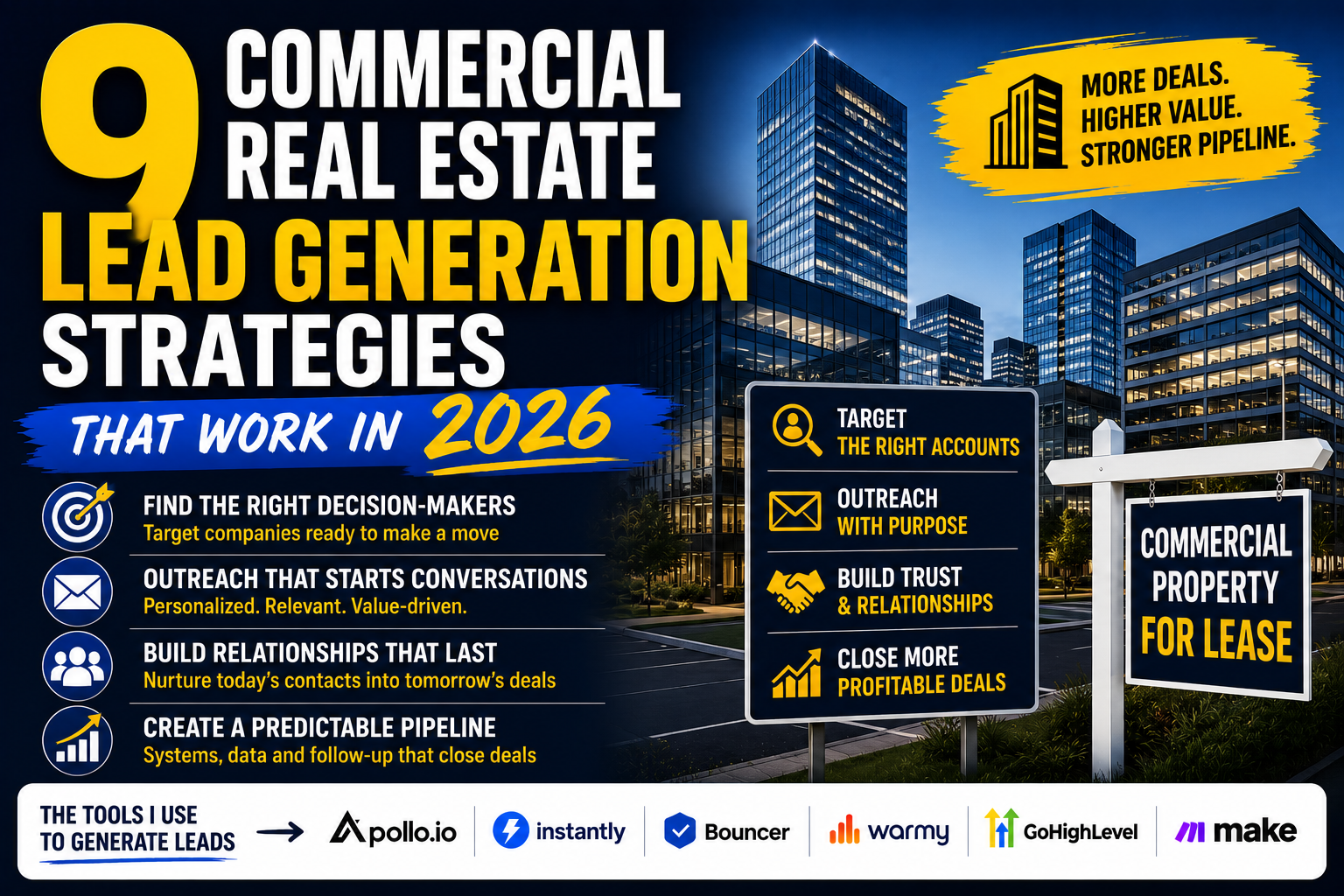
9 Commercial Real Estate Lead Generation Strategies I'd Use in 2026
Real Estate
Click here to checkout the software

Commercial real estate has a lead generation problem.
The potential value of one client can be enormous, but finding the right decision-maker is significantly harder than generating a residential buyer enquiry.
You're not simply looking for someone who wants a new home.
You might be trying to reach:
And that's exactly why I think commercial real estate requires a different approach.
If I were building a commercial real estate pipeline from scratch in 2026, these are the nine strategies I'd focus on.
This would be my first change.
A lot of real estate marketing is inbound:
Website.
SEO.
Social media.
Advertising.
Those channels matter, but commercial real estate gives you another advantage:
You can identify many of your potential clients before they ever contact you.
Instead of waiting for demand, build a database of the companies and decision-makers you actually want relationships with.
For example, if I specialised in industrial property in Manchester, I could create separate lists of:
Suddenly, prospecting becomes much more strategic.
This distinction matters.
I wouldn't download 20,000 random contacts and start emailing them.
I'd build an account list.
Imagine identifying 301 companies that genuinely fit your target market.
Then determine:
Who owns the relationship?
For a business looking for new premises, that might be the:
For an investment company, it could be:
Apollo can make this research significantly faster because you can filter companies and contacts by geography, industry, size, seniority, and other criteria.
Try it here: Apollo.io
Free plan available.
The objective isn't collecting more contacts.
It's finding the right ones.
This is where commercial prospecting becomes much more interesting.
Don't just ask:
Which companies could need property?
Ask:
Which companies might need property soon?
Look for signals such as:
A company hiring 70 people might need additional office space.
A logistics company entering a new region might need warehousing.
A manufacturer announcing a new production line may need industrial property.
Those are far stronger reasons to start a conversation than simply saying:
"Do you need commercial property?"
I'd avoid aggressive sales emails.
Commercial real estate transactions are relationship-driven and often take months.
Your first email doesn't need to close anything.
Its job is to create a conversation.
For example:
Hi James,
Saw you're expanding the Birmingham operation.
I'm researching demand for industrial space around the area and noticed the announcement.
Are you expecting the existing facility to accommodate the expansion, or are additional premises being considered?
That's fundamentally different from:
We are the leading commercial real estate agency...
The first is about them.
The second is about you.
This is probably where enormous amounts of potential commercial real estate revenue disappear.
Someone says:
"Maybe next year."
The agent makes a note somewhere.
Eleven months later...
Nobody remembers.
I'd build a pipeline like this:
A CRM such as GoHighLevel can centralise contacts, pipelines, reminders, forms, and automated follow-up.
Try it here: GoHighLevel
Free trial available.
The important part isn't the software.
It's making sure "call me in six months" actually means call them in six months.
If outbound becomes part of your prospecting strategy, don't immediately send hundreds of emails.
Commercial real estate is a relatively small market.
Burning your domain—or your reputation—isn't worth it.
I'd keep lists targeted and verify addresses before outreach.
For verification, Bouncer is one option.
Try it here: Bouncer
For businesses building dedicated outbound infrastructure, deliverability platforms such as Warmy can also help manage email reputation.
Try it here: Warmy
Quality matters far more than volume here.
There's a temptation to automate everything.
I wouldn't.
I'd automate:
But I wouldn't automate the actual relationship once a serious opportunity appears.
Make is useful for connecting the different parts of the workflow.
Try it here: Make
Free plan available.
For example:
Positive reply → CRM opportunity → assigned broker → follow-up task → notification
That saves administrative time without making the client experience robotic.
Here's where I'd combine outbound with SEO.
Most commercial property blogs are written for other property professionals.
I'd write for the actual client.
For example:
This is the strategy I'd be most interested in long term.
Don't treat your CRM as a contact database.
Turn it into market intelligence.
Track:
After several years, this becomes incredibly valuable.
You don't just know who's looking for property today.
You start understanding who could need property tomorrow.
That's a real competitive advantage.
If I were managing the system, I'd watch:
Notice what's missing?
Open rate.
It's useful operationally, but ultimately I care much more about whether outreach creates genuine commercial opportunities.
I wouldn't treat commercial real estate like ecommerce.
You're not trying to optimise someone into clicking "Buy Now."
A single relationship could be worth tens of thousands—or considerably more—over several years.
So I'd optimise for:
Relevance → Conversation → Trust → Timing → Transaction
Not:
Volume → Volume → Volume.
If I were generating commercial real estate leads in 2026, I'd combine two worlds.
Traditional real estate relationship building...
with modern B2B sales infrastructure.
I'd identify exactly which companies I wanted to work with.
I'd monitor signals suggesting they might need property.
I'd contact the right decision-makers with a genuine reason for reaching out.
And I'd build a CRM system that ensures opportunities aren't forgotten simply because the timing isn't right today.
Because in commercial real estate, the best lead isn't always the person looking for property right now.
Sometimes it's the person who will need it nine months from now—and remembers who helped them first.
Strong strategies include account-based prospecting, referrals, local SEO, networking, market intelligence, trigger-based outreach, content marketing, and systematic CRM follow-up.
It can be, particularly when targeting relevant business owners, investors, developers, and property decision-makers. Highly targeted outreach is generally more appropriate than mass emailing.
Potential prospects can be identified through business databases, LinkedIn, company announcements, planning information, local business news, property databases, networking, and existing relationships.
The right CRM depends on the business. More important than the platform itself is having clear pipeline stages, follow-up reminders, contact history, and a structured process for nurturing long-term opportunities.
Our latest news and trending topics